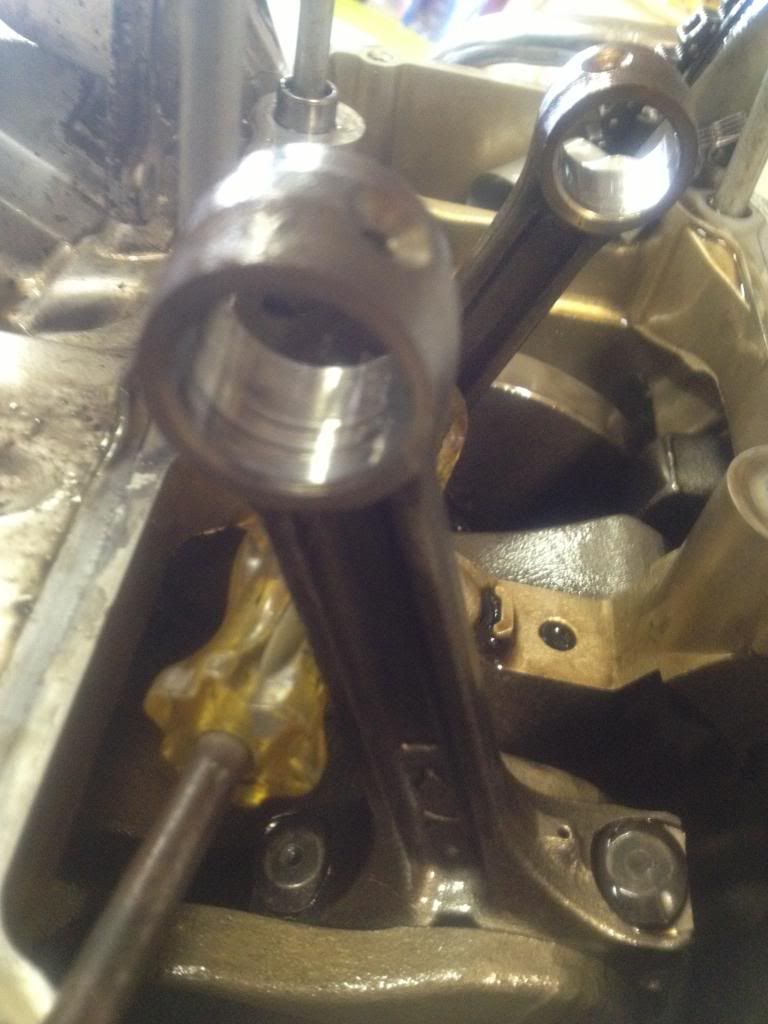
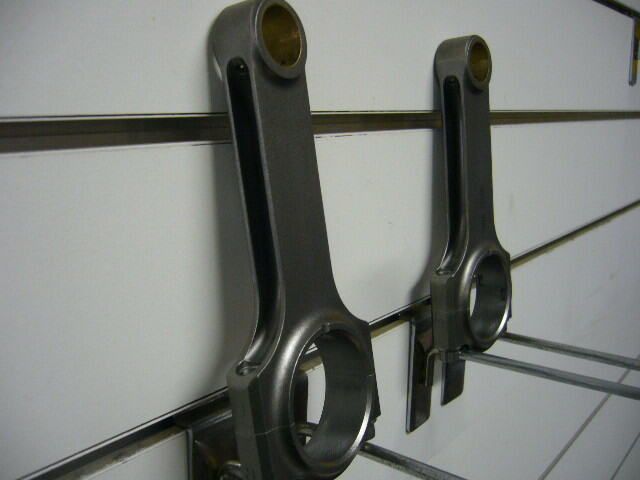
I was about to plastigauge the the crank n rods today when it came to my attention that the std OEM Trx Conrod has a hole to push oil from the crank and squirt it up under the piston but this does not appear on the Carrillo rods??
No doubt this oil would be for cooling and aiding in the feeding oil to the wrist pin.
Oil picked up from the scraper rings on the bores is fed through holes in the piston and also aid in this challenge but I still have to question the purpose of Carrillo not placing this extra feed to squirt oil under the pistons on their rod design.
Has anyone ever questioned this before??
Could this be a trade off as you begin to loose oil pressure from wear on the big end bearings you may retain a little more pressure a little longer instead of loosing this oil squirting out to decrease pressure further.
Could a little less oil fed under the piston be the sacrificial for gains to the main bearings of this action as they run a replaceable bush to do with wear on the small end on the rod.
I also noted only 1 hole right at the top of the rod to feed the wrist pin bush as compared to 2 on the std yamaha rod at about 30* either side of the top of the rod??
Call me pedantic but as Julius Sumner Miller says
" why is it so??? "
I'll post photos over the next day or two ..
CARRILLO ROD QUESTION
Moderators: trixynut, Mincehead, dicky, phuk72, Jak, Kevtrx849
-
cobbadiggabuddyblooo
- Site Sponsor
- Posts: 6809
- Joined: Thu Aug 28, 2008 9:19 am
- Location: Brisbane,Australia
CARRILLO ROD QUESTION
laughter is the best medicine
-
cobbadiggabuddyblooo
- Site Sponsor
- Posts: 6809
- Joined: Thu Aug 28, 2008 9:19 am
- Location: Brisbane,Australia

-
misterdimwiddy
- TRX-Enthusiast
- Posts: 474
- Joined: Thu Apr 08, 2010 6:14 am
- Location: Ware, Hertfordshire
Re: CARRILLO ROD QUESTION
I did notice this when looking at a set of used Carillos on ebay. Didn't buy them and peened my Yamaha rods so did not pursue the question.
Pretty certain there is no internal oil feed to the pin through the length of the rod either? The presence of the single drilled hole suggests that it is splash fed.
You would think Carillo would know what they are doing in their design work but I still suspect that my TRX suffered bore, piston skirt and small end wear because there was insufficient oil pressure feeding the underside of the pistons due to the mains and big ends being worn.
Removing the oil feed completely sounds like a recipe for disaster but I imagine many have used them without it terminal consequences.
Contacting Carillo would probably be the most conclusive approach? I would be interested to know if you get a response............
Pretty certain there is no internal oil feed to the pin through the length of the rod either? The presence of the single drilled hole suggests that it is splash fed.
You would think Carillo would know what they are doing in their design work but I still suspect that my TRX suffered bore, piston skirt and small end wear because there was insufficient oil pressure feeding the underside of the pistons due to the mains and big ends being worn.
Removing the oil feed completely sounds like a recipe for disaster but I imagine many have used them without it terminal consequences.
Contacting Carillo would probably be the most conclusive approach? I would be interested to know if you get a response............
-
cobbadiggabuddyblooo
- Site Sponsor
- Posts: 6809
- Joined: Thu Aug 28, 2008 9:19 am
- Location: Brisbane,Australia
Re: CARRILLO ROD QUESTION
http://www.cp-carrillo.com/Tech/RodTech ... fault.aspx
The BE oil squirter and 10-2 oclock PE bore oil feeds are offered as High performance options on their Carrillo rods.
I have sent an email to Carrillo so I await an answer to the reasoning and if this is their own decision to deem them not really necessary or at the discretion of whoever places the order to add in their eyes..High performance options.
I have read on a couple of other forums the exact same questions have been raised on the oil squirter and wrist pin feed with no real reasoning or answer from Carrillo quoted..
The BE oil squirter and 10-2 oclock PE bore oil feeds are offered as High performance options on their Carrillo rods.
I have sent an email to Carrillo so I await an answer to the reasoning and if this is their own decision to deem them not really necessary or at the discretion of whoever places the order to add in their eyes..High performance options.
I have read on a couple of other forums the exact same questions have been raised on the oil squirter and wrist pin feed with no real reasoning or answer from Carrillo quoted..
laughter is the best medicine
-
dandywarhol

- Site Sponsor
- Posts: 1639
- Joined: Fri Nov 24, 2006 12:56 pm
- Location: Edinburgh, Scotland
Re: CARRILLO ROD QUESTION
I can't directly answer your question but I ran a TDM900 with Carillo rods for 27,000 miles before I sold it on and had zero engine problems - I hadn't realised there was no piston cooling hole but the conversion was done before I bought it
1996 TRX 850, blue, Ohlins 46HRCLS, Race Tech Gold Valves, 0.90 springs, Venom pipes, R6 brakes............
1974 Yamaha RD250A, Candy Blue
1998 Yamaha SZR660, blue of course
1967 Yamaha TD1C 250, Blue and white
1974 Yamaha RD250A, Candy Blue
1998 Yamaha SZR660, blue of course
1967 Yamaha TD1C 250, Blue and white
-
cobbadiggabuddyblooo
- Site Sponsor
- Posts: 6809
- Joined: Thu Aug 28, 2008 9:19 am
- Location: Brisbane,Australia
Re: CARRILLO ROD QUESTION
I got my answer within 3 hrs after sending an e mail to Carrillo and the reply is listed below, which I can say is a lot better response than I've had from Dymag with 2 weeks and still waiting. 
Hello Brian,
We normally do not put the big end oil squirter in any of our connecting rods since this is putting a hole in one of the most highly stressed areas of the connecting rod and can lead to failures. This squirter is normally used to reduce thrust wear on the cylinder wall and in performance applications taking this out has showed no ill affect when doing so. We will get a decal set in the mail for you and if you have any other questions please feel free to contact me at any time.
Best regards,
Barry Deane
Sales Technician
Hello Brian,
We normally do not put the big end oil squirter in any of our connecting rods since this is putting a hole in one of the most highly stressed areas of the connecting rod and can lead to failures. This squirter is normally used to reduce thrust wear on the cylinder wall and in performance applications taking this out has showed no ill affect when doing so. We will get a decal set in the mail for you and if you have any other questions please feel free to contact me at any time.
Best regards,
Barry Deane
Sales Technician
laughter is the best medicine
-
misterdimwiddy
- TRX-Enthusiast
- Posts: 474
- Joined: Thu Apr 08, 2010 6:14 am
- Location: Ware, Hertfordshire
Re: CARRILLO ROD QUESTION
Makes you wonder why TRX motors often seem to suffer small end wear or pick up on the outer edge of the pin/rod contact area if the feed is redundant (despite the OEM rod having 2 pin oil feed holes at the small end).
If not related to crank oil pressure, the cause must be something else......................??
If not related to crank oil pressure, the cause must be something else......................??
-
cobbadiggabuddyblooo
- Site Sponsor
- Posts: 6809
- Joined: Thu Aug 28, 2008 9:19 am
- Location: Brisbane,Australia
Re: CARRILLO ROD QUESTION
The std rods from my TRX had wear in the small end but not critical.
The damage was from a previous owner and lack of oil and a rebuild within the first 50.000km. So I had placed another cruel at times 75,000km's on those exact same rods and still not to the detriment of the motor. So really a testament to the std rods.
Big end bearing where beginning to wear and as I found out through Yamaha race team mechanics as long as you don't over rev the motor to much, the TRX std rods are a strong reliable item.
But once you find yourself pushing the limiter and over rev and getting a little complacent ,the bottom cap distorts slightly causing a lower oil pressure due to the clearance getting closer and beyond 0.050" so the greater the chance of trouble occurring.
The further apart that tolerance on the big end bearings, the lower your oil pressure and the crank is one of the first points of lubrication from the pump so this drop in pressure here is to the detriment of the rest of the oil feed chain, like the cams while at idle.
A viscous cycle occurs from there if left too long.
The advantage of the Carrillo rods is that added strength if over revved as well as the lighter weight and reciprocating mass advantages plus being able to replace the sleeve in the small end if a drop in oil pressure does become an issue..
But for 95% of trx owners you will be flying high as long as they keep the oil levels up and try to keep the red zone for looking at and not loading and use the power available for loading and unloading in the black zone,
you will have clearance Clarence so your vector Victor will be under over..
The damage was from a previous owner and lack of oil and a rebuild within the first 50.000km. So I had placed another cruel at times 75,000km's on those exact same rods and still not to the detriment of the motor. So really a testament to the std rods.
Big end bearing where beginning to wear and as I found out through Yamaha race team mechanics as long as you don't over rev the motor to much, the TRX std rods are a strong reliable item.
But once you find yourself pushing the limiter and over rev and getting a little complacent ,the bottom cap distorts slightly causing a lower oil pressure due to the clearance getting closer and beyond 0.050" so the greater the chance of trouble occurring.
The further apart that tolerance on the big end bearings, the lower your oil pressure and the crank is one of the first points of lubrication from the pump so this drop in pressure here is to the detriment of the rest of the oil feed chain, like the cams while at idle.
A viscous cycle occurs from there if left too long.
The advantage of the Carrillo rods is that added strength if over revved as well as the lighter weight and reciprocating mass advantages plus being able to replace the sleeve in the small end if a drop in oil pressure does become an issue..
But for 95% of trx owners you will be flying high as long as they keep the oil levels up and try to keep the red zone for looking at and not loading and use the power available for loading and unloading in the black zone,
you will have clearance Clarence so your vector Victor will be under over..
laughter is the best medicine